
Big Pharma vs the hospitals
Plus that shadow money plays in the 4th CD, bread and roses, a new face at the Seattle Chamber, a lower bar for lawyers, and some recommended reading


The health care fight of the 2026 legislature is shaping up to be over the biggest federal subsidy almost nobody’s ever heard of.
That description is one point of agreement for the two sides of this fight — the Pharmaceutical Research and Manufacturers of America (PhRMA) and UW Medicine, acting as the tip of the spear for about 400 hospitals and clinics. But lawmakers, if they haven’t already gotten clued in about the federal 340B program, are about to get an earful. By one count, drug manufacturers have hired at least 45 contract lobbyists for the session. With the lobbying weight of the hospitals, it’ll be close to man-to-man coverage for the 149 lawmakers.
Here’s why you should care about this: The stakes are big. The 340b-qualified providers in the state say it’s worth at least $200 million to them, and $85M to UW Medicine alone. And Big Pharma is righteously ticked off at what it sees as an abuse of a once-small giveaway. This is complicated, so stick with us.

Quick background: The federal 340B program was started in 1992 to give safety-net hospitals access to discounted drugs for low-income patients. It requires drug makers to sell them deeply discounted pills, which the hospitals can then bill at regular prices to insurers, and pocket the difference, using the windfall to help the poor. Think: a $3,500 cancer drug can be bought by a 340B provider for a penny. It’s a backdoor subsidy.
It started to become a thing after Obamacare dramatically expanded Medicaid, and tons more hospitals qualified as safety nets. Spending spiked faster than lawmakers’ blood pressure at Sine Die, ballooning more than 600%, to more than $63B in 2023. It’s bigger than Medicare Part B as a federal drug pricing program. It’s weird that almost nobody (us included) has ever heard of it, but health care financing is inherently weird.
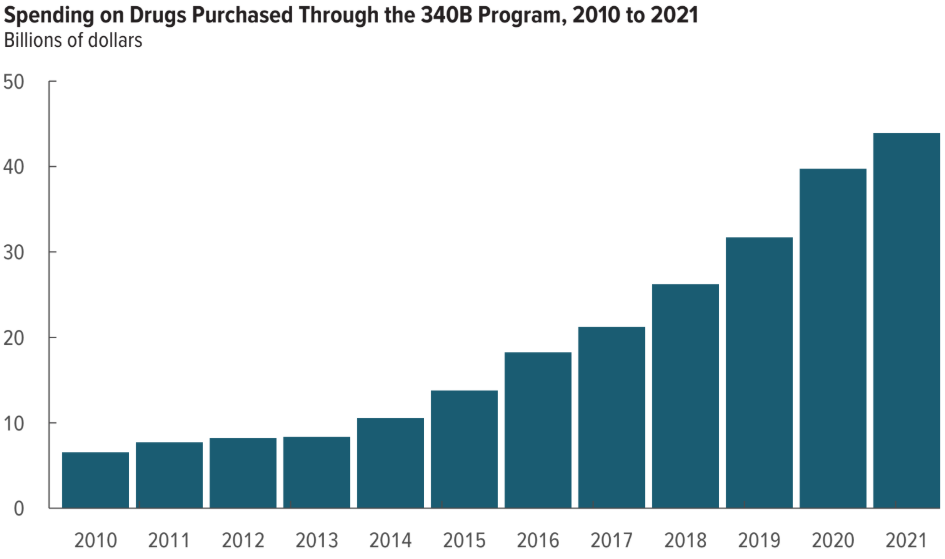
Congressional Budget Office 2025 report
Big Pharma tried to stanch the bleeding, seeking to prevent contract pharmacies from filling 340B prescriptions, but the feds ruled the other way in 2010 with advisory guidance. Since then, it’s been a pitched battle at the states. At least 20 states passed laws, most of them since 2020, to ensure the federal guidance on contact pharmacies is followed. There’s been a flurry of lawsuits, with federal trial and appellate courts ruling for and against the state laws, according to a congressional summary.
But there’s more: You might be thinking, is it bad that massively profitable Big Pharma has to give some blood to subsidise poor hospitals? We hear you. But… as the original intent got warped over the years, those poor little hospitals have now come to include the behemoth medical systems — United Health, CVS, etc. And there’s virtually no look-through to ensure the savings they pocket actually go toward care for the poor, and toward a CEO’s helipad at the lake house. Great reporting by The New York Times showed how corporate medicine was weaponising the program. A report commissioned by U.S. Senate Republicans found that a third of the 340B savings went straight into medical systems’ financial portfolios. The federal agency that oversees 340B is essentially asleep on the job, rarely auditing. When they do, they find problems.1
The fight is now in Olympia with a bill by Rep. My-Linh Thai, D-Bellevue, who said she spent most of the interim researching this mess. Her pre-filed bill would require manufacturers to distribute 340B drugs to contract pharmacies. She knows she has some educating to do, but hopes to keep it simple by emphasizing patient access. Consider: a patient in a rural area has to travel a bit to see their doc, who writes a 340B-subsized prescription. If the doc’s clinic can’t send the script to a contract pharmacy in that patient’s hometown, that’s a barrier to access.
Her bill, unlike those in some other states, doesn’t beef up transparency to see if the pocketed savings are actually used for patient care, which will be a talking point for that fleet of Big Pharma lobbyists.
That fleet of lobbyists for Big Pharma is likely to argue the bill expands who gets access to 340B. They have a point: current state rules don’t support contract pharmacies.2 Thai disputes that her bill is an expansion, saying it just requires compliance with the 2010 federal guidance.
One other wrinkle: Gov. Bob Ferguson’s budget tinkered with 340B, assuming state savings of $7.5M by shifting prescriptions written for Medicaid managed care patients to a different drug discount program. But to get a sense of how sweet the 340B program is for qualified hospitals, that move would cost the 400-or-so nonprofit health care clinics statewide at least $110M in reimbursements. The move adds a new front to this session’s battle over 340B.
Takeaway: Big Pharma is not what you’d call a sympathetic victim, regardless of the Rube Goldberg mechanics of 340B. But they do make a case that the backdoor subsidy gets passed on to insurers, public and private, and that there’s no way to know where the savings really go. On the other hand, hospitals have really taken it in the teeth in recent state and federal budgets. And… did we mention Big Pharma is playing the victim?
JM
You read it here first, folks
Last month we brought you news of a new PAC fueled by Central Washington money that looked poised to boost Yakima County Commissioner Amanda McKinney’s bid for the U.S. House seat being vacated by GOP Congressman Dan Newhouse.
Well, that PAC, Washington Rising, just rolled out a new campaign designed to highlight McKinney’s conservative, pro-Trump bona fides. Here’s the spot:
McKinney is looking to shoulder out former NASCAR driver and noted gun-fondler Jerrod Sessler, who challenged Newhouse from the right with Donald Trump’s endorsement in 2024 and got 46 percent of the vote in an R-on-R showdown in November. The bigger challenge for McKinney vs. Sessler would likely be the August primary in the deep red district.
The Washington Rising ad even features a nuanced nod to the gun-rights issue: A shot of somebody chambering a round in a bolt-action hunting rifle, which is notably not one of the military-style weapons Sessler likes to play with.
A big spend this early — we’re told it’s six figures — looks aimed at muscling out Sessler before the filing deadline in May. We hear there’s a campaign brewing to persuade the president to switch horses. The man has been known to change his mind.
PQ
On bread and roses…
We enjoy a double-barreled history-and-poetry reference here, so we’re going to call out now-Mayor Katie Wilson for rolling out “bread and roses” during her inaugural speech.
The phrase, from early 20th Century suffragist and labor politics, refers to the idea that everyone should have both the necessities of life and sun, music and art. It remains a popular slogan on the left to this day and drew approval from the crowd at Wilson’s swearing-in.
It dates back to a 1910 speech by suffragist Helen Todd. Here’s the relevant section:
“Not at once; but woman is the mothering element in the world and her vote will go toward helping forward the time when life’s Bread, which is home, shelter and security, and the Roses of life, music, education, nature and books, shall be the heritage of every child that is born in the country, in the government of which she has a voice.”
That in turn inspired a poem by James Oppenheim, and the phrase is associated with a massive 1912 textile worker strike in Lawrence, Massachusetts, largely by female workers.
The poem has been set to music multiple times, and recorded by artists including Judy Collins and Ani DiFranco. It was performed at the recent inauguration of New York Mayor Zohran Mamdani.
Here’s the final verse:
As we come marching, marching, we bring the Greater Days—
The rising of the women means the rising of the race.
No more the drudge and idler—ten that toil where one reposes—
But a sharing of life’s glories: Bread and Roses, Bread and Roses.
Legit affordability and wealth-inequality questions aside, we should point out that 2026 Seattle, with the highest minimum wage in the country and beefy wage-and-hour law, is a long way from the dystopian sweatshops of early 20th century America.
PQ
An interesting new face atop the Seattle Chamber
Among the things that happened while we were peaced out for the holidays was former state Senator and Director of Commerce Joe Nguyễn’s move to the top job at the Seattle Chamber.
Nguyễn takes over the reins of the city’s preeminent business association from Rachel Smith, who recently left to run the Washington Roundtable, which represents the state’s largest employers. There’s a substantial overlap between the two groups, including name-brand companies such as Amazon,3 Boeing, and Microsoft. Both Nguyễn and Smith, acting in their prior roles, were on the panel on the state of Washington State’s economy at our Re-Wire Policy Conference last month. If you missed it, our friends at TVW have you covered.
But we bring this up because it’s kind of a remarkable arc for both Nguyễn and the chamber. He was elected to the Senate in 2018, coming out of nowhere to beat an establishment-backed candidate from the left in the solidly blue 34th Legislative District, which includes West Seattle and Vashon Island, home to Observer World Headquarters.4
Nguyễn came to Olympia as something of a progressive rabble-rouser. But after a splashy but unsuccessful challenge to then-King County Executive Dow Constantine in 2021, he became the powerful chair of the Senate Environment, Energy, & Technology Committee and leaned into the role of dealmaker, which helped lead to his appointment to Gov. Bob Ferguson’s cabinet.
The chamber has need of a dealmaker with progressive credentials as it enters the uncertain political waters of Seattle Mayor Katie Wilson’s administration, which has many folks in the business community very nervous.
PQ
Recommended Listening and Reading
Will Katie Wilson save Seattle with pragmatism?
That’s the title of a good predictions episode from the Seattle Nice podcast, with wishcasting for Mayor Katie and analysis that bears monitoring. Josh Feit, a former Stranger editor, predicted Wilson will surprise critics to her right (that’s a vast expanse) with effectiveness. And political consultant Sandeep Kaushik forecast that her biggest fights will be with progressives, including stop-the-sweeps advocates. He noted that Wilson’s pledge to create 4,000 housing units for homeless people– something close to a moonshot — may need to be front-loaded to fulfill her desire to move people off the streets before the FIFA World Cup games begin in June. Tidier streets come at a cost.
It’s an interesting prediction because it is premised on Seattle’s first socialist mayor governing with a pragmatic hand. That’s something we’re hearing a fair amount of hope for, with Wilson sending up some smoke signals by retaining the SPD police chief and appointing some seasoned hands to her inner cabinet.
JM
Best sentences of 2025
Frank Bruni at The New York Times returned to his “best sentences” list with some humdingers from across the American journalism-verse. “... Back when America had attorneys general who didn’t think an emoluments clause was the disclaimer on a moisturizer.” … “One of the reasons MAGA conservatives admire Putin is that they see him as an ally against their ultimate enemy — the ethnic studies program at Columbia.”
On lawmakers struggling to regulate AI, “It feels, at times, like watching policymakers on horseback, struggling to install seatbelts on a passing Lamborghini.” On drug ads, “You will frolic on the beach at sunset psoriasis-free, with a golden retriever, smiling into the distance. You also may experience sudden loss of cardiac function, seizures of the arms or intermittent explosive ear discharge. Talk to your doctor.”
It’s a good read and a belly laugh or two.
JM
Thanks for your attention. This is a free edition of The Washington Observer, an independent newsletter on politics, government, and the influence thereof. It’s made possible by our paid subscribers. If you’re not among them, go ahead and hit the button to get access to all our stuff and the warm glow of supporting independent journalism.
A dubious pup questions the strategy

UW Medicine argues it’s $85m in 340b savings barely makes a dent in its annual $200M-plus charity care bill.
The Health Care Authority says it “cannot provide an estimate of the difference in costs across programs attributable to 340B” because the information is confidential. So much for transparency.
Amazon is one of the sponsors of our Re-Wire Policy Conference, which is part of how we pay the bills around here.
Paul, then still living his former life in West Seattle as a hired-gun communications operative, was in the losing camp on that race, and would like several interminable hours he spent at the 34th District Democrats’ endorsement meeting back.