
Primary takeaways
Pedersen crushes, Supremes races look interesting for November, bad news abounds for the GOP, and Grace City’s parishioners might want their money back


Editor’s Note: As always, we reserve the right to be wrong about some of this stuff. Something like half the vote is still outstanding and things might change.
All that money spent defending Senate Majority Leader Jaimie Pedersen in Seattle’s deep-blue 43rd Legislative District either worked like crazy or was largely unnecessary. As of Wednesday morning, Pedersen was crushing Hannah Sabio-Howell, his challenger from the left, with more than 71 percent of the vote. The uber-progressive case against Pedersen was always shaky at best—he’s a hero of the gay-rights movement and the architect of the income tax—and the result indicates that there just isn’t much territory to his left. Pedersen and allies spent more than $500,000 to make sure.

Among the losers in that race is Concerned Taxpayers of Washington, which tried to toss gasoline on the political fire in Pedersen’s back yard to little effect. A similar campaign from the conservative PAC against House Majority Leader Joe Fitzgibbon in the nearly-as-blue 34th also fizzled. Fitzgibbon had more than 73 percent of the vote after Tuesday’s count.
Further editor’s note: We’re going to go ahead and give the Secretary of State’s revamped election results page zero stars. Our list of grievances is long, but we especially miss the handy color-coded county-by-county maps.
Supreme results tee up intriguing races for the fall
It doesn’t take much squinting at Tuesday’s vote counts in the Supreme Court races for conservative money to see the best opportunity in a decade for a win. And the results confirmed the conventional wisdom of judicial races: in the non-partisan elections, voters figure out which political lane candidates are in and act accordingly, especially in a primary electorate that tends to be more purely partisan. Ferguson appointee Theo Angelis showed his lack of name recognition in virtually tying with Dave Larson, the GOP-endorsed/court reformer retired judge for position 5, which was vacated by Justice Barbara Madsen’s mid-cycle retirement. Angelis can assume he’ll get a chunk of Thurston County judge Sharonda Amamilo’s 21%1, but there’s opportunity for the Concerned Taxpayers crowd to amplify Larson’s sharp critiques of Democratic governors’ oft-used appointment process to tug the court left.
Similarly, Ferguson appointee Colleen Melody got just over 51% (that will probably rise when King County, where she got a near-supermajority, counts more votes). But tax lawyer Scott Edwards, who will also advance to November, is already getting some right-lane independent expenditure support, and has a solid resume and the kind of white-bread name voters seem to like in judges.
The most interesting unanswered question from Tuesday’s Supreme races is the battle between appeals court judge Mike Diaz and King County judge Jaime Hawk for a spot on the November ballot vs. Mason County judge David Stevens. Diaz won King County and a handful of Latino-heavy communities in Eastern Washington, but Hawk won almost a vast majority of counties. But Diaz is not out because King County — where he leads Hawk by nine points — has a voter turnout so far of 18% vs. a projected 40%-ish. Lots of votes to count.
Not on Tuesday’s ballot, but likely to be a barnburner in November, is the race between appeals court judge Ian Birk and King County judge Sean O’Donnell, who’ve both raised a ton of money and occupy distinct lanes. Birk has been showered with cash by the plaintiff’s bar, and O’Donnell has a prosecutorial background that should appeal to Big Business smart money.
JM
Signs of the blue wave in SW WA
Southwest Washington has become the state’s political hot spot, with the only swing Congressional district and a handful of legislative seats that run purple. The area looks slightly more blue in Tuesday’s results, perhaps giving us an early warning alert of the much-talked-about blue wave in November. Maverick Democratic U.S. Rep. Marie Gluesenkamp Perez has to be feeling good despite tying state Senate Minority leader John Braun, R-Centralia, because a good 15% of the electorate went for progressive challenger Brent Hennrich. There’s going to be a lot of money spent in the next few months persuading those Democrats to hold their noses and go for MGP.
And Democrats similarly came out looking strong in the 17th and 18th LD districts in Vancouver and its suburbs, despite more than $400K flowing from a conservative IE attacking the Dems. Rep. Kevin Waters, R-Stevenson, previously won handily in the 17th, but after redistricting dragged the district across the Cascades, and with the political drag of Trump, he’s now nearly nine points down to flight nurse Ben Christly. Diana Perez, a Vancouver City Councilmember, had an even larger margin on incumbent Rep. David Steube, R-Washougal. In the 18th, which more closely hugs Vancouver, labor-aligned candidate Deken Letinich was cashing in on the bad publicity around Rep. John Ley’s voting fraud conviction, and disabilities advocate Randi Knott narrowly led Rep. Stephanie McClintock, R-Vancouver.
JM
Ds look strong in 26
In the very swing-y 26th LD, Renee Hernandez Greenfield cruised past Tedd Wetherbee in a Democratic party clash for the right to face Republican Katy Cornell in November. Greenfield locked up most of the Dems’ friends in labor and party-line positions on the millionaires’ tax, while Wetherbee, one of the biggest cannabis slingers in WA, leaned on a business-friendly message and a contrarian take on the tax. Wetherbee, who listed more than $1M a year in income on his disclosure forms, did not self-finance and didn’t outdistance Greenfield in the fund race, which he may now be regretting.
Cornell, meanwhile, has been a fundraising juggernaut and is seen as a priority for the GOP to hold a seat vacated by Rep. Michelle Valdez this year. But she’s got less than 45 percent of the vote so far. If Greenfield’s friends in labor deem her worthy, the 26th House race is likely to see a firehose of spending.
In the other House race, incumbent Democrat Adison Richards had just 35 percent of the vote, but that’s largely because he’s got a primary opponent from his own party. Natalie Bornfleth pulled in 21 percent of the vote, while Republican challenger David Olson, who ran unsuccessfully for Superintendent of Public Instruction two years ago, had less than 44 percent.
Democratic Sen. Deb Krishnadasan, who won a bonkers-expensive special election last year after she was appointed to replace now-Congresswoman Emily Randall, cruised through the primary with more than 56 percent of the vote. That may be because her opponent, Gary Parker, employs the consultant best known for that Loren Culp grift back in 2020.
JM/PQ
The 42nd’s Democrat challenger emerges
The Democrat in the race for 42nd LD might have a name.
Early results show Port of Bellingham Commissioner Michael Shepard is ahead in the race for the left lane with some 27% of the vote. His opponent, progressive Eamonn Collins, is trailing him at 24%. Shepard won a swath of endorsements from Democratic lawmakers and business community while Collins has sizable union muscle behind him.
Combined, the two are both ahead of Blaine Republican Erika Creydt, whose campaign garnered some 46% of the vote so far – something you’d expect as the sole candidate on the right. That’s a big deal in the very purple 42nd which tends to see the vote split down the middle.
The showing above is interesting as far as the money race goes. Neither Shepard nor Collins ran expensive campaigns. Creydt, however, amassed a six-figure war chest ahead of the primary that’s now running on empty. Her campaign can likely expect a flood of GOP money in the fall to wrestle for outgoing state senator Sharon Shewmake’s seat.
TG
Not much help for the GOP in the 10th
The once red-hot race to turn the waters around Whidbey Island red in the statehouse might have cooled considerably per Tuesday’s primary results in the 10th legislative district.
Current tallies show Republican Robert (Chili) Hicks trailing his opponent, state Rep. Clyde Shavers, D-Clinton, by double digits as of Tuesday night. The Secretary of State’s office had Hicks with a mere 41% of the vote and Shavers with a sizable 58%.
The above isn’t great news for Hicks, a veteran and Stanwood City Council member, whose tough-on-crime culture warrior campaign could run short on steam and money come fall should the aforementioned read like a red flag. It’s a big boost for Shavers, whose original campaign for statehouse was marred by allegations he misrepresented his military service overseas.
Hicks and Shavers are both advancing to the general in lieu of other opponents, which may ultimately boil down to whether MAGA fever has broken in the district, whose veteran community lends the right a leg-up in election season.
Meanwhile, House Deputy Majority Leader Dave Paul, D-Oak Harbor, pulled ahead of his Republican opponents via a double-digit lead.
The 10th is one of just two districts in the statewide with divided representation. Republican Ron Muzzall holds the Senate seat, which isn’t on the ballot this year.
TG
Beware the mayor’s endorsement
Seattle Mayor Katie Wilson’s no-good very-bad week continued Tuesday as her endorsements of far-left lane candidates — Sabio-Howell over Pedersen in the 43rd LD and Ron Davis in the 46th — fizzled. Davis ran a quixotic campaign against The Stranger’s nod to political novice Will Dreher in their bid to unseat seven-term Rep. Gerry Pollet in the North Seattle district. Dreher is beating Davis 2-to-1 in the race for a fall challenge of Pollet, who got well over 50% of the vote, suggesting one of the old lions of the state House wasn’t as vulnerable as progressive dreamers thought this cycle.
If Dreher continues to lean into his AI-warrior campaign platform, it will be interesting to see if Big Tech spends in the race, as it has against other regulation-loving candidates nationally. Meanwhile, Jonathan, a longtime 46th LD voter, will not miss the stream of texts from Davis’ campaign.
JM
Mixed results on purging the income tax apostates
In the fancy precincts of the Eastside’s 48th Legislative District, famously pro-business moderate Rep. Amy Walen had just over 50 percent of the vote against progressive challenger Jessica Forsythe. Walen, a lonely voice in the House Democratic caucus against the income tax on the state’s highest earners, was aggressively targeted by New Direction, the labor-driven PAC dedicated to protecting and expanding the progressives’ majorities in the Legislature. Walen, D-Kirkland, had significant support from PACs backed by the business lobby. Expect Round 2 in the fall to get very expensive.
In the far grittier 29th Legislative District in Pierce County, progressive challenger Krista Perez led incumbent Rep. Melanie Morgan by five whole votes after Tuesday’s count. Like Walen, Morgan, D-Parkland, voted against the income tax, but she’s also toting a load of unpleasant workplace-behavior baggage. Look for a concerted push to show her the door in November.
PQ
A failed experiment in theocracy
Among the biggest losers — at least collectively — looks to be the congregation of Grace City Church, who put more than $300K of their hard-earned money behind one of the Wenatchee-area evangelical megachurch’s pastors in an attempt to oust incumbent Republican state Rep. Mike Steele in the 12th Legislative District. That pastor, Adam James, was running a slow third behind Steele and Democrat Maggie Adams after Tuesday’s count.
The stated goal of this effort was to begin a movement to subjugate the secular state to the church’s militant, muscular, and very male version of Christianity.2 The primary voters of the 12th appear to have recoiled from that idea. For more, we commend the work of our brother in news Dominick Bonny, who has been all over this race.
In possibly related news, the district’s other House member, GOP Rep. Brian Burnett, was narrowly trailing Democrat Stacy Willoughby after Tuesday’s count.
PQ
Recommended reading:
Solar peaces out
Greg Kim at the Seattle Times can fill you in on what appears to be the final chapter in the saga of the Central Washington solar farm that couldn’t. The Connecticut-based energy company behind the massive project east of Wenatchee at the foot of Badger Mountain pulled out without comment, but longstanding opposition from the tribes, environmentalists and others speaks for itself. At completion, the site would have rivaled the size of downtown Seattle – precisely why its would-be neighbors were a hard nope on the venture. The dearth of federal tax credits for greener energy since Trump returned to the White House didn’t help either. Figuring out how to route transmission lines across the Cascades might have been the most expensive question. It remains one of the chief bottlenecks for just about any energy project built to power big cities around the Sound that keep their backyard.
TG
A high-energy land fight
Yet another land race in Central Washington has locals sharpening their pitchforks, this time in Klickitat County where farmers are bracing themselves for a water war with Big Data. As Emma Renly tells it over at the Washington State Standard, local officials are already fixing to rewrite the rulebook on how and when farmland is swallowed up by energy facilities that have been sniffing around the region. That includes a rumored AI data center. But energy developers say they have farmers’ backs, as two AI-generated farmers can attest.
TG
Thanks for your attention. This is a free edition of The Washington Observer, an independent newsletter on politics, government, and the influence thereof. It’s made possible by our paid subscribers. If you’re not among them go ahead and hit the button to get access to all our stuff and the warm glow of supporting independent journalism.
We double-dog demand you be done writing
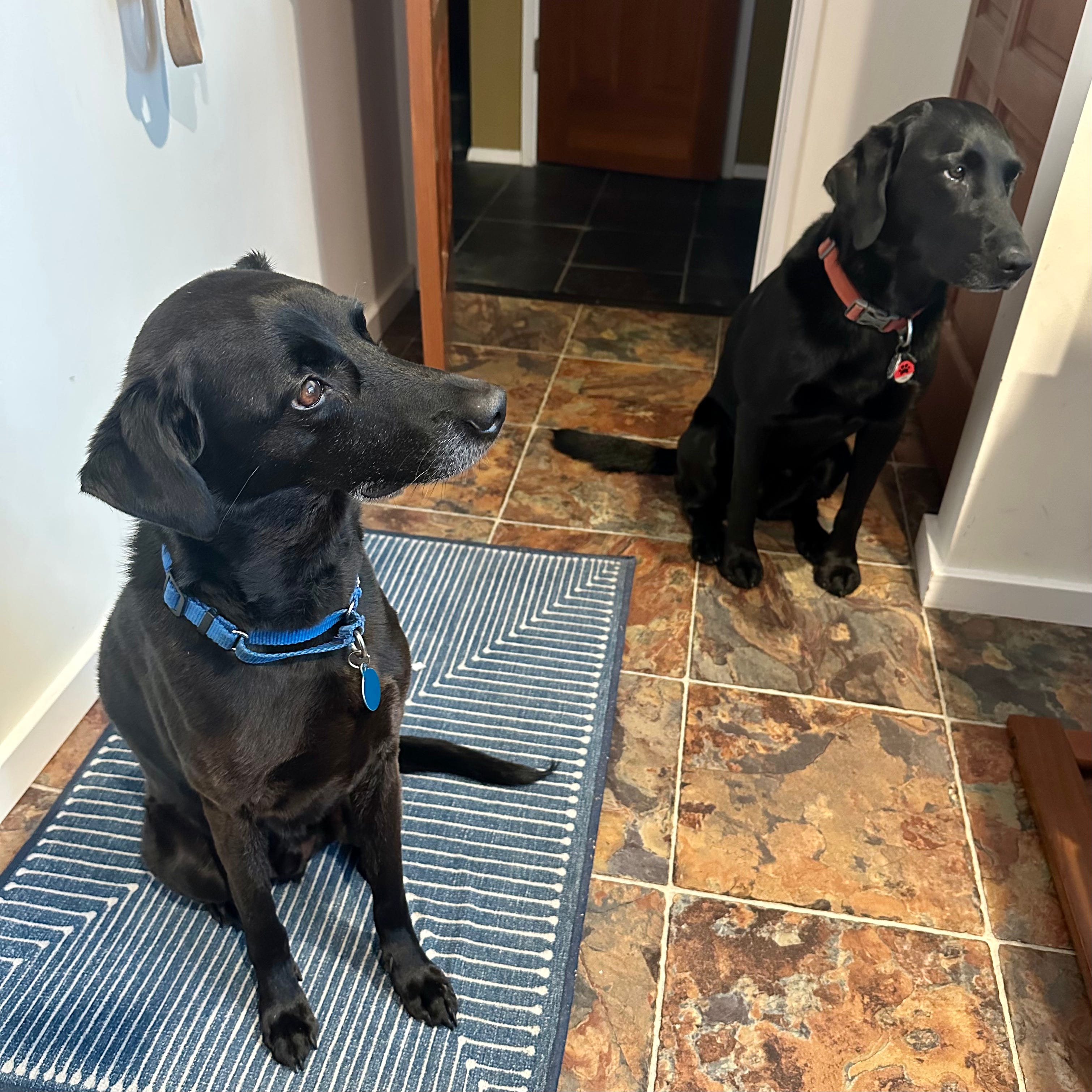
Kobe and Arya are so done with the primary takeaways. Want to see your pet in this space? Drop us a photo and some caption material.
We’ve spilled ink on The Stranger’s endorsement veering this cycle, so it’s fair to note The Seattle Times somewhat surprising endorsement of Amamilo aged like milk. She ran in the left lane, winning minority bar association nods along with the uber-progressive Urbanist, which does not tend to be pavement the Times camps out in. Amamilo didn’t even come in second in her home county.
A seat on the back bench of a badly outnumbered minority would not have provided much leverage for this crusade.
Re: 46th LD: Ron Davis is not a "progressive dreamer" — he's just another market urbanist who thinks trickle down economics is "progressive" in the housing arena. It is no more progressive there than anywhere else.
Baumgartner at only 48% is a shocking drop from >60% two years ago. Doubt he'll lose in November, but the fact that it's even close should tell you all you need to know about which way the winds are blowing...