
Closing in on the primary...
A eat-the-rich campaign in the 29th LD and a litmus test in the 17th, plus cave-diving into the budget crisis and some recommended reading


With the August primary just around the corner, The Observer is taking a look at legislative races that may give a clue to themes likely to be shotgun blasted at voters in the fall campaigns. Democrats’ intraparty warfare and progressive solutions to affordability are a feature in the 29th LD, and in Southwest WA, candidates on the left and right are scraping over some of the few purplish districts left.
One item to watch: if the Democrats are going to ride an ephemeral blue wave to wider margins, or even a super-majority, the House Democratic Campaign Committee should be a player. But fundraising is lagging this cycle, with less than $500K raised, versus about $1.5M raised at this point in 2024.
We hear that’s due in part to D-friendly money (aka Big Labor) shoveling cash to the millionaire’s tax defense effort. It also seems like incumbents’ surplus funds may not be flowing into the mothership in this cycle, when lots of incumbents are facing challenges from the left. The lag doesn’t make a difference now because the HDCC doesn’t typically give out cash until after the primaries, but it’s something to keep an eye on this summer.
JM
The intraparty crusade to eat the rich
Krista Perez wants you to know the time is nigh for millionaires and their friend circle. The Tacoma Democrat said as much in a spicy new campaign ad which counts her opponent, state Rep. Melanie Morgan, among those aforementioned friends.
In it, Perez mills through a grocery store aisle with her daughter in tow and a colorful onscreen “Mom” placard for the uninitiated, all while calling out Morgan for doing the rich and powerful a solid by voting against the Millionaires Tax.
“When she joined Republicans to vote against the Millionaires Tax, I felt betrayed,” Perez tells us. “Shouldn’t they pay their fair share?”
The 30-second shot across the bow is a striking message to Morgan, a four-term Democrat who rode the blue wave to Olympia amid Trump’s first stint in the White House. You could read it as a sign of the times for aggressive progressives itching to clean the House of moderates while the GOP is kaput in suburban Washington.
Here’s why you should care about this: Morgan’s vote in particular sticks out like a sore thumb in the Democratic caucus. Between both chambers, nine Democrats voted no. But all of them – save for Morgan – reside in fiercely contested purple districts where defending a yes vote could’ve been a taller order than in a liberal bastion like Tacoma. It also appears there’s a dearth of millionaires in her district so Simone Carter over at the Olympian found, based on Department of Revenue data.
The intraparty challenge comes at an inopportune time for Morgan, whose alleged misconduct-in-the-workplace haven’t boosted her waning profile in the House caucus. If nothing else, she’s far behind in the endorsement race. Her short list of top-tier nods — Gov. Bob Ferguson and Secretary of State Steve Hobbs — all hail outside the 29th Legislative District.
By contrast, Perez has won a thumbs up from just about anyone who’s anyone on the left, from the Washington State Labor Council to the puissant Washington Education Association and even the 29th LD Democrats. Seven out of eight Tacoma City Councilmembers endorsed her to boot.
Morgan is running against a story as much as an opponent. Perez, who works a day job at the Department of Commerce, couches her campaign as a lifeline for hard-pressed families like hers who immigrated to Walla Walla for farm work. The long and the short of her to-do list includes cracking down on wage theft, shoring up childcare, and tinkering with the Growth Management Act to ease life for homebuilders.
For her part, Morgan is running on experience. That translates to a smattering of past and present titles from Deputy Majority Floor Leader and Vice Chair of the House Agriculture and Natural Resources Committee. Bills of hers that made the news include the Crown Act, which allows students (especially those of color) to wear their hair how they please.
One way or the other, the race for the 29th will be a cheap decision for the lobbies. Morgan and Perez have only amassed $51,000 and $29,000 respectively, leaving most of the contest up to word of mouth. Morgan has a few upturned thumbs from Big Business associations like the Washington Bankers Association, Regence, and the Tribes. Perez is mostly drawing nickels and dimes from Jill and Joe Blow.
A new breed of Democrat is emerging on the progressive left in America. A true blue district like the 29th may play no small part in shaping how they govern in Washington.
TG
A litmus test in the 17th LD
If Democrats are going to grow their substantial majority, the 17th legislative district in Southwest Washington is as good a place as any.
Since the court-ordered redistricting of the neighboring 14th LD around Yakima, the 17th has shifted from being a red-leaning suburban Vancouver district to one that crosses the Cascades as it hugs the Columbia River from east Vancouver to Goldendale and the Yakama Nation, looking like a fist in a glove with the 14th. It’s a district with curious geographic coherence, and its borders seem more designed to fulfill a federal court order to enfranchise Latino voters in the Yakima basin than anything else.
The result: Once-ample GOP margins have shrunk. Kamala Harris beat Trump by 9% in the district in 2024. Sen. Paul Harris, R-Vancouver, saw his traditional lopsided victories narrow to a 2% squeaker that year. The most vulnerable incumbent1 in the district this cycle is Rep. David Stuebe, a career Marine Corps vet and Washougal Mayor, who won by less than 1,000 votes over Democrat Terri Niles in 2024.
This cycle, Vancouver city councilwoman Diana Perez hopes to ride a projected blue wave that, according to some internal polling, is giving generic Democrats a 4-5% bump.
Stuebe has good-ol’-boy vibes and talks about unity in divided times, and has the type of small-scale legislative wins that reflect a freshman operating in a deep minority. He’s the ranking Republican on the House Local Government committee, which makes sense. But Perez probably has a higher profile in the district from her perch on the Vancouver council. Her bio spotlights her longtime work as a U.S. Forest Service biologist and fire prevention specialist who was hit by the DOGE purge. She’s attacking Stuebe as a lock-step Trump Republican, but probably wants to talk as little as possible about the millionaire’s tax, which she has said she’d have voted for, with some reservations.
Neither the funds race and nor the endorsement game offer much of a surprise. Both have raised about $80K, with Stuebe getting max donations from auto dealers, the Realtors and contractors groups.Perez has netted big checks from PACs associated with electricians and various Democratic interests. The endorsements shake out similarly — big business giving Stuebe the check mark, and Perez gets backed by labor and liberal social issues groups.
That makes this race a potential litmus test for voters’ larger mood and that theoretical blue wave. We’ll keep an eye out for the primary results.
JM
Spelunking the state budget crises
In the waning days of the 2026 legislative session, Democrats acceded to a request/demand from the business community to take a deep look at whopper budget deficits that bloomed even as revenue grew this biennium.
In legislative parlance, “a deep look” can mean a task force and a report that gathers dust. On Monday, we got the first look at the results of Section 907 of the supplemental budget bill, and there seems to be reason to suggest this one might produce something interesting. (We reserve the right to an eye-roll later.)
Why you should care about this: The state budget has flirted with disaster now for two sessions, and seems headed there again with deficits projected for 2027-29. Disaster means Democrats and their widening majorities fail to achieve goals that got them elected — i.e., universal child care and better school funding — while they routinely crank the dials on taxes that worsen affordability. Republicans, meanwhile, loudly say we told you so, but to no avail.
The Joint Legislative-Executive Committee on Budget Transparency and Fiscal Sustainability includes the usual suspects of Democratic and Republican budget-writers and state agency and budget staff, but it also includes some interesting additions. On the business side, Washington Roundtable president Rachel Smith and Bellevue Chamber president Joe Fain (a former Senate GOP budget-writer himself) repped businesses cranky that the state’s now-annual budget crises triggered a host of new taxes. On the other side were State Labor Council president April Sims and SEIU 755 Secretary-Treasurer Adam Glickman, who rep members who prefer fat state coffers to negotiate against.
The committee drew in staff from the Pew Charitable Trusts for national perspective. In the table-setting meeting on Monday, Pew staff noted that WA’s tax system was pretty stable compared to other states, but Evergreen State had unusually small rainy day funds. It also noted that other states track budget gimmicks like “one-time long-term spending,” which got a knowing chuckle from the committee.
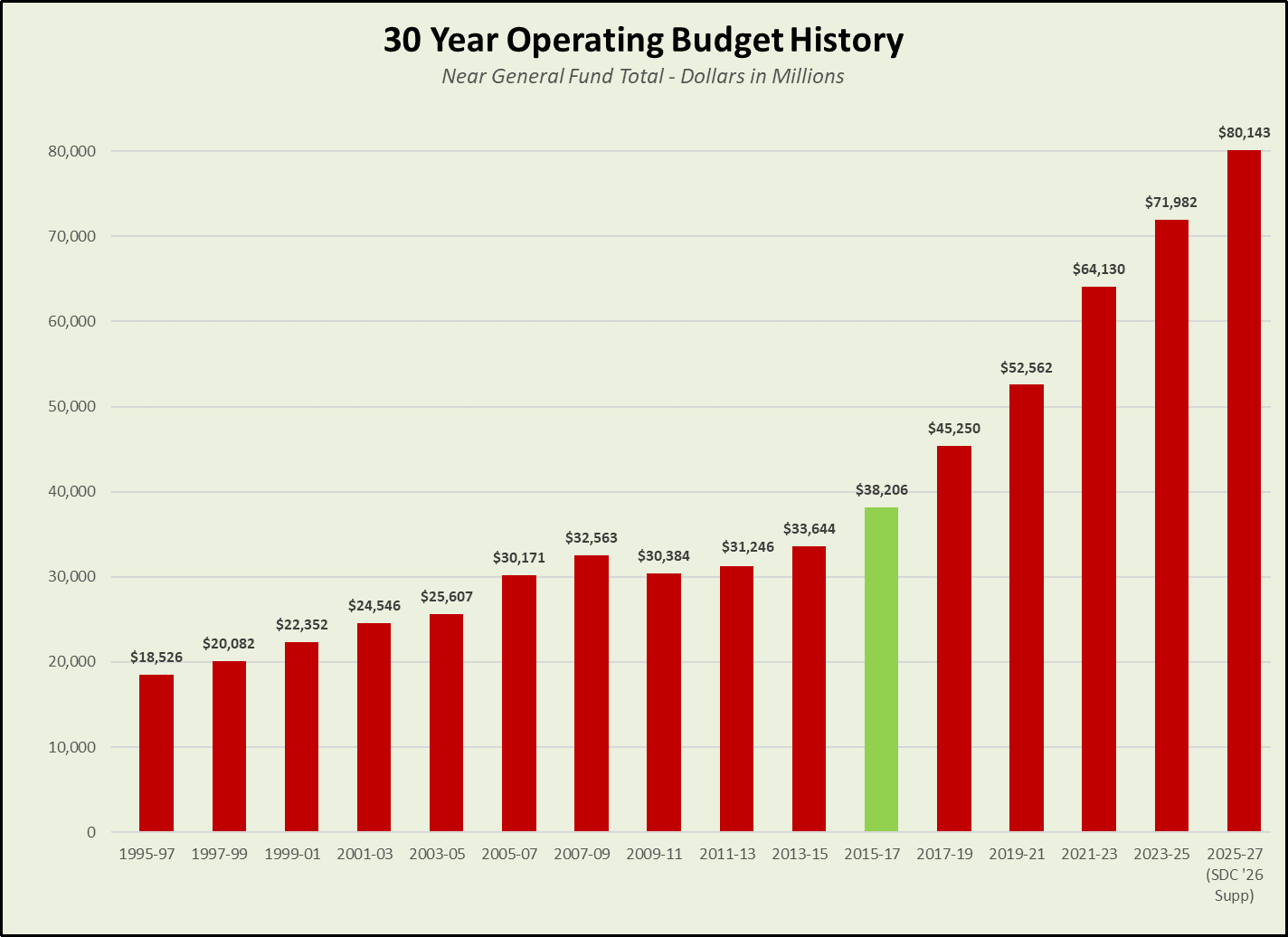
Senate Republicans distributed this handy chart last session to spotlight the last time they helped write the state budget, in 2015-17. Partisan, yes, but it tells a story.
The inclusion of Big Labor is interesting because A) organized labor is Democrats’ biggest funder; B) the cost of collective bargaining agreements have generally been up and to the right; and C) the CBAs are not routinely baked into budget projects, which contributes to the sudden fiscal crises that led to this committee.
And inclusion of Big Business is interesting because A) it has successfully planted a narrative that fiscal responsibility is killing the golden goose of WA’s economy; B) it has had little meaningful success heading off tax hikes; and C) how big a role Big Biz or its members play in Let’s Go Washington’s millionaire’s tax campaign is an open question.
This “deep look” is a two-year gig, with a report due in December on how the trendlines and budget processes led to near-crises, and what other states do to avoid them. Next December, the group is slated to spelunk the administrative state.
JM
Recommended Reading
Just what is “gambling” anyway?
Alexis Weisand of The Seattle Times brings us the news that a King County judge has at least temporarily banned prediction market site Kalshi from offering sports betting in Washington State. Should the ruling hold up, it would be a big win for the state’s Native American tribes. A few years back, the tribes persuaded the Legislature to limit Washington sports betting to in-person wagers at tribal casinos.2 The growth of Kalshi has no doubt taken a substantial bite out of that pie because folks like to bet from the comfort of the couch. Kalshi offers betting markets on the outcome of all manner of things, from business transactions to political races to, yes, sporting events. It argues that only the federal government has the power to regulate such markets. Earlier this year, the Third U.S. Circuit Court of Appeals ruled against New Jersey in a similar case. This one seems headed for the Big Supremes.
PQ
A spicy race for a normally boring local office
Our brother in news Dominick Bonny has another spicy offering from the weird world of Chelan County politics. A challenger for county auditor is running on some wild discrepancies in property assessment in the county that appear to cut substantial property tax breaks to some of its more affluent and influential citizens, shifting the tax burden to less fortunate folks.
PQ
How much weight does an ex-governor or two swing?
Republicans have been busily trying to make hay in recent days out of former Govs. Gary Locke and Christine Gregoire, both Democrats, essentially calling the Democratic Legislature and their gubernatorial successors reckless spendthrifts for ballooning budgets and a raft of new and increased taxes. Danny Westneat digs into this attempt at elder statesmanship in his column in The Seattle Times. It should be noted that neither Locke nor Gregoire dealt with anything resembling the big progressive majorities in the Legislature. Don’t hold your breath waiting for the current power structure in Olympia to smack its collective forehead and get budgetary religion without an actual setback from the voters.
PQ
Thanks for your attention. This is a free edition of The Washington Observer, an independent newsletter on politics, government, and the influence thereof. It’s made possible by our paid subscribers. If you’re not among them go ahead and hit the button to get access to all our stuff and the warm glow of supporting independent journalism.
It’s good to be a beach dog in the summer

Steube’s House seatmate, two-term Rep. Kevin Waters, R-Stevenson, is considered less vulnerable, although he faces a challenge from flight nurse Ben Christly. Waters, a well-liked moderate beloved of the business lobby, is the founder of Backwoods Brewing.
App-based wagering is allowed on casino property; presumably there’s a lot of betting from the parking lot